
I enjoy hiking, and after spending much of late winter and early spring unable to enjoy this activity because of a leg injury, I am grateful to finally be able to get moving again. Of course, summer hiking comes with summer bugs. While, I am not a mosquito magnet, I still get bit more than I’d like, and am always searching for effective repellent.
In my near ten years living and hiking in the Hudson Valley, I have tried many products promising to keep the bugs away. Some have worked well, others not so much. I often found I had to sacrifice my own personal comfort for effectiveness. I wanted a product that works without the common annoyances of common insect repellents.
What Is Picaridin?
I was fortunate to be sent some samples of picaridin-based insect repellant products from Sawyer*. Admittedly, I wasn’t familiar with picaridin and needed to do some research to learn more. I discovered that picaridin has been around since the 1980s and is a common alternative to DEET.
Picaridin is a synthetic compound that resembles the natural compound called perine, which is found plants used to make black pepper. Although it has been used in Europe and Australia for many years, it only just came available in the United States about 20 years ago, according to the National Pesticide Information Center.
Whenever I use a DEET-based product, I have gagging reaction to the smell. Unlike DEET, picaridin doesn’t have a strong odor, which appealed to me, as I want to repel mosquitos not every other human around me.
Does Picaridin Protect Against Insect Bite
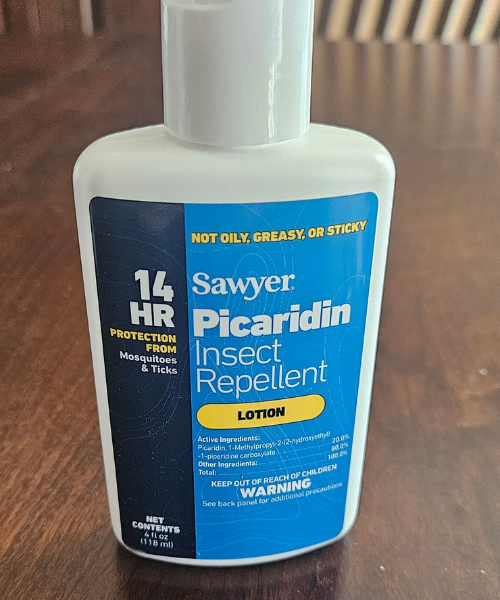
I put Sawyer’s products to the test during our family vacation to Lake George. While it wasn’t overly buggy, there were a few mosquitos buzzing around. I traveled with the regular spray, continuous spray and lotion. I also tested them at my parent’s home, which tends to get a good amount of mosquitos.
Of the three products, I found the lotion to be the most effective at keeping the bugs at bay. I believe this is because, like with sunscreen, the ability to apply directly to the skin and ensure full coverage is key to getting the maximum protection.
I did end up with one mosquito bite, and it is hard to say what the results would have been if I used a different product or none at all. Still, one bite is better than 20 bites, and even when using the strongest DEET-infused products I still get bit, so I wouldn’t rule out this brand just because one ambitious mosquito got through.
Picaridin Is A Good Alternative To DEET
Is picaridin a good alternative to DEET? I would say yes. As I mentioned above, I didn’t notice a significant decrease in benefits and using picaridin has many advantages. Namely, the lack of odor, I found it to be very neutral, and even forgot I had it on. While there are other insect repellent brands that use picaridin, I liked Sawyer because the products are non-greasy and do not irritate my skin.
Regardless of what insect repellent you use, there is always the possibility of being bit. Wearing protective clothing, including long pants and sturdy shoes, especially when exploring wooded or high-grass areas is crucial for ensuring you avoid harmful disease from insect bites.
Ultimate Test
Last summer, my son came home from sleepaway camp covered in bite marks. Out of everyone in our family, he seems to be the most appealing to mosquitoes. This year, I am sending him to camp with multiple Sawyer products and hoping he will find some relief. Check back later for another update to see if Sawyer picaridin-based insect repellants can hold up to the ultimate test: keeping bugs at bay for three-and-a-half weeks at summer camp.
*Review Disclosure: I was provided product samples in exchange for a possible review. All views expressed are my own.
 Maybe I'll Shower Today
Leave a comment